Author: admin

  • Six Months in Riyadh: What I Got Wrong About This Market

    What I Got Wrong About Language

    I arrived in Riyadh thinking language would be my primary barrier. I do not speak Arabic. I assumed that in a country where Arabic is the language of government, daily life, and cultural identity, my inability to communicate in the language would be a constant professional obstacle.

    It has been less of a barrier than I expected, and a different kind of barrier than I anticipated. The professional infrastructure and construction sector in Riyadh operates largely in English at the senior level. Major programs, international firms, government agencies with significant international engagement — the working language in formal professional settings is English, and that English is often very good.

    The language barrier I actually encounter is not in the meeting room. It is in the informal conversation before the meeting starts, or the discussion over coffee afterward, or the exchange between colleagues in Arabic that happens while I am present. That is where context gets built. That is where relationships deepen. And that is where my Arabic deficit is actually felt — in the texture of informal relationship-building that I cannot fully participate in.

    What I Got Wrong About Pace

    I arrived with a North American sense of how quickly business develops: meeting, capabilities presentation, proposal, engagement — six to eight weeks from first conversation to contract in a well-aligned situation. In Riyadh, the first conversation is genuinely just the first conversation. The relationship needs more investment than I was prepared to make before business becomes a natural topic.

    The adjustment has taken longer than I expected and has been more valuable than I anticipated. The relationships I have built in Riyadh through the slower, relationship-first development process are qualitatively different from the professional relationships I built in Canada. They feel more genuine, more durable, and more likely to produce sustained collaboration rather than transactional engagement.

    I have also adjusted my expectation of what ‘fast’ means in a different context. When the right principal is present and aligned, decisions here move extremely quickly. The bottleneck is relationship establishment, not decision-making. Once the relationship foundation exists, the pace can be exceptional.

    What I Got Wrong About Market Sophistication

    I came to the Saudi market thinking I would be bringing technical capability that was not locally available. In some specific areas, that is true. But the Saudi engineering and project management community is more experienced, more internationally trained, and more analytically demanding than I had assumed before arriving.

    The first conversations I had with Saudi infrastructure professionals recalibrated my assumption immediately. These are professionals who have delivered programs at scales I was still learning to navigate. Who have managed multi-billion dollar programs with international consortia. Who have built institutional knowledge across sectors that the Kingdom has been developing for decades. My contribution is real, but it needs to be positioned as additive to a sophisticated existing capability, not as a replacement for it.

    What I Got Right

    The thing I got most right was the decision to commit. Not to come and go — to be present for events and meetings and then return to Canada. But to actually bring my family here, to integrate into the city, to be available for the informal conversations as much as the formal meetings.

    That commitment is visible and it matters. It changes the nature of every professional relationship I have here. Being present in Riyadh — not visiting it — is the single most important decision I have made since relocating.

    Six months in. A lot still to learn. I am grateful for every professional conversation that has been part of that learning.
  • The NCA OTCC Compliance Gap: Why 77% of Saudi Infrastructure Operators Are Exposed

    The Compliance Gap Is Real and Documented

    The National Cybersecurity Authority’s assessments of OT cybersecurity posture across Saudi Arabia’s critical infrastructure sectors consistently find a significant gap between the OTCC requirements and the actual security posture of operational facilities. Industry analysis suggests that a substantial majority of OT environments in the Kingdom’s critical infrastructure — estimates range from 65-80% — do not fully meet the OTCC baseline requirements.

    This is not a surprising finding to anyone who has assessed OT environments in the Kingdom. Most of the facilities currently operating in Saudi Arabia’s energy, water, transport, and industrial sectors were designed and commissioned before OT cybersecurity was a defined engineering requirement. The control systems are functional and often well-maintained from a process engineering perspective. But the cybersecurity dimensions — network segmentation, access control, monitoring, incident response capability — were not part of the original design scope because they were not required when the systems were built.

    Why the Gap Exists

    The OT cybersecurity compliance gap in Saudi Arabia has three primary sources.

    Legacy systems designed without security. Most operational OT environments in the Kingdom were commissioned between the 1980s and the 2010s — before OT cybersecurity frameworks existed and before the threat landscape had developed to the point where OT attacks were considered a realistic operational risk. The engineers who designed those systems were not negligent; they designed to the standards and threat understanding of their time. But the systems they designed are now connected to broader networks in ways that were not anticipated, running software versions that are no longer supported, and exposed to threat actors whose capability has grown significantly since commissioning.

    The IT/OT organizational split. In most Saudi critical infrastructure operators, the IT function and the OT function are organizationally separate and often have limited interaction. IT security teams understand network security, identity management, and cyber incident response in the IT context. OT engineering teams understand process control, instrumentation, and operational continuity. The intersection — OT cybersecurity — requires both sets of expertise, and the organizational structure rarely creates effective collaboration between them.

    Project scope exclusion. Even new facilities being designed and commissioned now frequently do not include OT cybersecurity requirements in their design scope. The project team is an engineering team. The controls integrator is a specialist in process control, not cybersecurity. Unless OT cybersecurity requirements are explicitly included in the project scope — which requires the project owner to specify them and the project team to price them — they will not appear in the delivered system.

    The Regulatory Trend

    The NCA’s enforcement engagement across sectors has been progressively increasing. The OTCC is not a voluntary framework and the NCA’s posture has shifted from guidance and awareness to compliance assessment and enforcement. Organizations that are not addressing the compliance gap are accumulating regulatory exposure that is distinct from — and in addition to — the operational security risk they carry.

    The enforcement approach the NCA has developed draws on the model established by other mature regulatory frameworks for critical infrastructure: assessment of compliance posture against the framework requirements, identification of material gaps, issuance of remediation requirements with defined timelines, and escalating consequence for organizations that fail to demonstrate progress against those requirements.

    What Organizations Need to Do

    The practical path to OTCC compliance starts with an honest assessment of current posture. Not a self-assessment produced by the OT engineering team, which will reflect what the team knows how to assess, but an independent OT security assessment conducted by specialists with both OT knowledge and cybersecurity expertise. That assessment establishes the gap against the OTCC framework, prioritizes findings by risk level, and produces a remediation roadmap that the organization can execute against.

    For facilities currently in design or construction, the most cost-effective approach is to address OT security requirements in the design scope before the network architecture is locked and before control system procurement is completed. Changing a network architecture at 60% design is expensive. Changing it after commissioning is very expensive. Not changing it and receiving a compliance finding is potentially more expensive still.

    Concept Dash offers complimentary OT gap assessments for infrastructure operators in the Kingdom. If your facility is among the majority that have not yet fully addressed the OTCC compliance requirements, a conversation now is significantly less expensive than a compliance enforcement action later. Visit conceptdash.ca or send a direct message.

  • Etihad Rail: Lessons From the GCC’s 1,200km Multi-Country Rail Network

    The Ambition

    Etihad Rail is building a 1,200-kilometre national rail network in the UAE — and ultimately, a GCC-spanning freight and passenger rail system that connects six countries from Kuwait to Oman, covering more than 2,000 kilometres of new rail infrastructure. It is among the most ambitious rail projects in the world by any measure: geographic scale, multi-country governance complexity, desert terrain challenges, and the technical challenge of integrating with existing rail systems in Saudi Arabia and other GCC states.

    The UAE network itself — the initial, purely domestic portion of Etihad Rail’s mandate — crosses 14 of the UAE’s 35 local government areas, passes through protected environmental zones, and must navigate the infrastructure density of the Emirate of Abu Dhabi’s industrial corridor and the Emirate of Sharjah’s urban areas. The freight mandate includes sulfur export from ADNOC facilities in the south, industrial goods from the Khalifa Industrial Zone (KIZAD), and import logistics for the UAE’s consumer economy. The passenger mandate — still in planning and regulatory development — adds another layer of design and operational complexity.

    The Governance Challenge

    Building a railway that crosses sovereign borders requires a governance framework that most infrastructure programs do not need to address. The GCC Rail Authority — the intergovernmental body established to coordinate the network — brings together transport ministries from six countries with different regulatory environments, different technical standards traditions, different financing approaches, and different national priorities for how the network serves their economies.

    The interoperability challenge alone is significant. A freight wagon loaded in Kuwait needs to run without transhipment or modification to Muscat. The track gauge, loading gauge, coupling systems, braking standards, and signalling protocols need to be consistent across the full network. Achieving that consistency across six separate national systems — each with its own existing rail infrastructure, its own engineering standards community, and its own procurement traditions — required years of technical harmonization work before the first shovel was in the ground.

    The commercial governance challenge is equally complex. Who owns the infrastructure in each country? Who operates the trains? How are access charges structured for a freight operator whose journey spans three national networks? How are the revenue and cost of maintaining each section of the network allocated between national authorities? These questions have answers — developed through years of intergovernmental negotiation — but the answers are complex, and managing them through the construction phase and into operations requires governance capability of a high order.

    Technical Delivery Challenges

    The terrain across the UAE and GCC presents genuine engineering challenges. The Rub al Khali — the Empty Quarter — presents the most extreme combination of terrain, temperature, and remoteness in the network’s routing. Track infrastructure in a sand sea that can produce dunes metres high in hours of wind requires design solutions that simply do not exist in the standard rail engineering handbook. The Etihad Rail engineering team worked with geotechnical specialists and desert environment engineers to develop solutions for desert rail that will be relevant references for any rail program in the Arabian Peninsula.

    Temperature extremes challenge rail in two ways. The extreme heat of GCC summers (regularly exceeding 45°C ambient temperature, with rail temperatures potentially 20°C higher) affects rail expansion rates, track geometry stability, and the performance envelope of rolling stock and signalling equipment. Rail designed to standard European or North American temperature ranges is not suitable without modification. The Etihad Rail program has contributed to an emerging body of practice for desert-climate rail engineering that Saudi Arabia’s rail programs are directly benefiting from.

    Lessons for Saudi Arabia’s Rail Programs

    Saudi Arabia’s own rail ambitions — Saudi Railway Organization’s network expansion, the Landbridge project connecting the Red Sea to the Gulf, Riyadh Metro expansions, and the rail elements of major development programs — can draw on Etihad Rail’s experience across several dimensions.

    Governance structures for large rail programs need to be designed before construction begins, not developed in response to problems that arise during delivery. The intergovernmental framework Etihad Rail operates within took years to develop and is still evolving. For Saudi Arabia’s programs, the equivalent challenge is coordinating across multiple government entities — MISA, SAR, the Royal Commission for Riyadh City, Neom, the various sectoral authorities — each with legitimate interests in how the rail network is designed, built, and operated.

    Desert terrain engineering requires specialist knowledge that is not widely available in the global rail engineering community. Programs that engage that specialist knowledge early — in pre-feasibility and preliminary design — avoid expensive design changes when reality at the construction site differs from standard-environment assumptions.

    Commercial frameworks for rail need to address the full life of the asset, not just the construction phase. Rail infrastructure is typically in service for 40-60 years. The commercial and governance arrangements established at project inception will shape the network’s operational performance across that entire horizon.

  • 4D Scheduling and Digital Twins: How Time-Linked Modelling Is Changing Saudi Mega-Program Delivery

    Why Time Matters in 3D

    A 3D BIM model tells you what a building or infrastructure asset looks like — its geometry, its components, its spatial relationships. It is a powerful tool for coordination, clash detection, and design visualization. It does not tell you anything about when things will be built, in what sequence, or how construction of one element affects the construction of another.

    4D BIM adds the dimension of time. The 3D model is linked to the construction programme — each model element connected to the schedule activity that will produce it. The result is an animated visualization of the construction sequence: at any point in the project timeline, the 4D model shows what has been built, what is currently under construction, and what is planned for the coming weeks and months — in three spatial dimensions, at the scale of the actual site.

    This is not a visualization gimmick. For complex infrastructure programs where sequence interdependencies are numerous and the cost of getting sequence wrong is high, 4D scheduling is one of the most powerful project control tools available. And for Saudi Arabia’s giga-project programs — where sequences of unprecedented complexity are being planned and executed simultaneously — the value of 4D is proportional to the complexity being managed.

    Programme Validation During Preconstruction

    The primary value of 4D BIM in preconstruction is programme validation: using the animated sequence model to test whether the proposed construction programme is actually executable, before construction starts.

    In a traditional scheduling exercise, the project’s programme is developed as a network of activities and dependencies in a scheduling tool (Primavera P6, Microsoft Project). The critical path is identified, the durations are estimated, and the resources are assigned. The schedule is then reviewed in tabular or Gantt chart format — a two-dimensional representation of a three-dimensional construction sequence problem.

    The 4D model makes the sequence spatial. Problems that are invisible in a Gantt chart — two work fronts competing for the same crane radius, a staging area that gets consumed before materials stored there have been offloaded, a scaffold structure that blocks access needed by a subsequent trade — become visible in the 4D animation. They can be resolved before construction starts, at a fraction of the cost of resolving them after work has begun.

    On the Metrolinx programs I managed, 4D became an essential tool for programme validation in preconstruction. The station rehabilitation sequences — working in live operational environments with tight access constraints and mandatory service windows — benefited enormously from 4D validation before the construction method was committed to contract.

    Progress Monitoring During Construction

    4D’s value does not end when construction begins. During construction, the 4D model evolves into a progress monitoring tool — the actual sequence of construction compared against the planned sequence in a visual format that makes schedule variance immediately understandable.

    The integration of drone survey data, laser scanning, and photogrammetry with 4D models is producing progress monitoring capability that is transforming how large sites are managed. Weekly drone surveys of a construction site can be processed into 3D point clouds that are overlaid on the BIM model, showing precisely what has been built and what has not. That progress data is then linked to the programme, generating automated schedule performance metrics at the component level.

    For Saudi Arabia’s mega-project programs — NEOM’s various districts, the Red Sea Project infrastructure, Diriyah’s heritage and commercial development — the ability to monitor progress at this level of detail and speed is essential for managing construction activities across multiple sites simultaneously.

    Digital Twins: From Delivery to Operations

    A digital twin is the natural extension of 4D BIM from construction into operations. The BIM model, enriched with as-built data, commissioning records, and operational sensor data, becomes a real-time representation of the operational asset — updated continuously as the physical asset changes and as operational data flows in from IoT sensors, monitoring systems, and maintenance records.

    For infrastructure operators in Saudi Arabia, digital twins enable predictive maintenance (identifying maintenance needs before failures occur by analyzing sensor data trends), operational optimization (running simulations of operational scenarios to identify efficiency improvements), regulatory compliance (maintaining a current, auditable record of asset condition and maintenance history), and emergency management (enabling emergency responders to understand asset layout and systems status in real time during incidents).

    Concept Dash’s digital twin practice is focused on the Saudi Arabia market, where the scale and pace of asset delivery creates an exceptional opportunity for digital twin deployment. We work with program teams from design stage to ensure that the BIM models being developed for construction are structured for digital twin handover — not retrofitted into a digital twin format after construction is complete, which loses most of the value of the investment made during design and construction.

  • Building Task Force: Why the Construction Industry Needs AI-Native Project Management Software

    The Software Problem in Construction

    The construction industry manages trillions of dollars of economic activity annually with project management tools that were architected in the 1990s. Primavera P6 was originally released in 1999. The fundamental interface paradigm of most construction project management software — Gantt charts, activity codes, resource levelling — was designed for a world where project data lived in spreadsheets and schedule updates were faxed.

    The programs being delivered today — particularly in the GCC, where giga-projects are routinely measured in tens of billions of dollars and hundreds of interconnected work packages — are too complex, too fast-moving, and too data-rich for software built on those paradigms to manage effectively. The data exists. The construction industry generates enormous amounts of it — from progress reports, RFI logs, change order registers, procurement systems, site sensors, drone surveys, and BIM models. The problem is that the software cannot synthesize it. Project teams are swimming in data and starving for insight.

    What Task Force Is Built To Do

    Task Force is an AI-native construction management platform built from the ground up for the way complex infrastructure programs actually work. Not adapted from manufacturing ERP. Not built on a scheduling tool and extended with modules. Built for construction, with AI at the core of the data processing and decision-support architecture from day one.

    The platform operates across three streams. The Engineering stream manages design deliverables, review workflows, technical submittals, and the BIM model as a living project control instrument — not as a static reference document. The HRM stream manages the workforce: mobilization, competency management, safety training compliance, productivity tracking, and the labour resource planning that is one of the most consistently underserved areas in construction project management software. The Construction Intelligence stream is where the AI capability is most visible: synthesizing data from across the project to identify schedule risk, cost variance signals, productivity trend changes, and supply chain exposure before they become confirmed problems.

    The AI Application in Project Controls

    The specific AI applications in Task Force are not generative AI for document creation — although the platform includes that capability. They are predictive and pattern-recognition applications trained on construction project data: the patterns of early schedule warning signals, the cost trend patterns that precede overruns, the productivity decline patterns that precede workforce performance problems.

    Schedule risk detection, for example, uses a combination of leading indicator data (RFI response times, drawing release trends, procurement lead time tracking, resource utilization patterns) and the historical patterns of how schedule risk materializes on programs of similar scale and type. The output is not a status report. It is a signal: these three data trends are consistent with a pattern that has produced a 6-8 week delay in similar programs, here are the specific activities most at risk, and here are the recovery options worth evaluating.

    This is the kind of early warning capability that the construction industry needs and that current software does not provide. We are building it into the core of Task Force because it cannot be added as a module on top of a traditional scheduling tool — it requires access to the full project data environment from the beginning.

    The Road Ahead

    Task Force is currently in development, with our India-based development team progressing through the build plan and our seed funding round advancing. For infrastructure professionals and construction organizations who want to understand the platform’s capability, I am available for direct conversations. We are also seeking introductions to program owners in the GCC who are looking for better project intelligence on programs of the scale and complexity where Task Force’s capability is most relevant.

  • Where OT Security Meets BIM: The Convergence That Infrastructure Engineers Must Understand

    The Convergence Point

    Building Information Modelling has evolved well beyond its origins as a 3D drafting tool. Modern BIM models for major infrastructure projects contain not just the geometric information of the physical asset, but rich data about the systems embedded in that asset: mechanical equipment specifications, electrical system design, control panel locations, network infrastructure routing, instrumentation placement, and increasingly, the data architecture of the operational technology networks that will control the facility once it is commissioned.

    That evolution has created a convergence point that the infrastructure engineering community has not fully recognized: BIM models now contain detailed information about OT network topology — information that has significant security implications if the model is not itself properly secured and if the OT design information it contains is not reviewed through a cybersecurity lens during the design phase.

    What BIM Models Reveal About OT Systems

    A detailed BIM model for a water treatment plant, a power substation, or a district cooling facility contains the location of every PLC cabinet, every SCADA workstation, every HMI, every network switch in the control system, and the routing of the control system cabling between them. It contains the logical architecture of the control system — which equipment is controlled by which PLC, how the PLCs communicate with each other and with the supervisory SCADA system, and how the SCADA system connects to the corporate IT network for reporting and remote access.

    This information is essential for the engineering team designing and installing the control system. It is also a detailed map of the OT network topology that a threat actor with access to the BIM model could use to plan an attack on the facility’s operational technology systems. The same information that makes the BIM model useful for engineering is what makes it valuable to a malicious actor — if they can access it.

    The Design Stage Integration Opportunity

    The convergence of BIM and OT cybersecurity creates a significant opportunity that most infrastructure projects are not currently capturing: the integration of OT security review into the BIM design process at the point when the OT network architecture is being developed.

    When OT security specialists review the BIM model at the network architecture design stage — typically at 30-40% design completion — they can identify security weaknesses in the OT network design and recommend modifications before the architecture is committed to detailed design and procurement. A network segmentation gap that is visible in the BIM model at 35% design is resolved through a design revision. The same gap discovered during commissioning requires physical network modifications, software reconfiguration, and delays to the commissioning programme.

    The practical process is straightforward: include OT security review as a formal gate in the BIM design review process, alongside structural, mechanical, and electrical reviews. The OT security reviewer examines the control system design elements of the BIM model against the applicable security framework (IEC 62443, NCA OTCC) and produces a findings report with design-stage recommendations. The project team incorporates the recommendations into the design before the review milestone.

    Digital Twin Security

    The convergence extends into operations through digital twins. A digital twin that contains real-time OT operational data — sensor readings, equipment status, network traffic patterns — is an information asset that requires the same security consideration as the OT environment itself. If the digital twin is connected to the OT network and accessible through the corporate IT environment or externally, the security of that connection needs to be designed as carefully as the security of the OT network it mirrors.

    Concept Dash’s combined BIM and OT cybersecurity capability — integrating our digital twin practice with our OT security team — positions us to provide this integrated design review for infrastructure projects in Saudi Arabia. If you are developing a BIM model for a facility that will have significant OT infrastructure, the time to integrate the security review is now, not at commissioning. Contact us to discuss how this can be incorporated into your project’s design workflow.

  • Crossrail: The £4.1 Billion Overrun That Taught the World About Mega-Project Controls

    The Scale of the Problem

    Crossrail — now the Elizabeth Line — is London’s newest and most celebrated rail link. 100 kilometres of route, 41 stations, a 21-kilometre central tunnel section under the city, and the capacity to carry 200 million passengers annually. When it finally opened to the public in May 2022, it was genuinely transformational for London’s mobility.

    It was also, by the time of opening, £4.1 billion over its 2010 budget and three and a half years behind its original completion target. The story of how that happened is one of the most instructive case studies in mega-project delivery available to infrastructure professionals anywhere in the world.

    The Original Budget and Schedule

    The 2010 budget for Crossrail was £14.8 billion. By the time the project reached its 2018 construction completion milestone — the point at which the new stations had been built and the central section tunnelling was complete — the cost had grown to approximately £17 billion. The project management team advised Transport for London and the government that the project would open in December 2018.

    It did not open in December 2018. The systems integration phase — the process of integrating train control software, rolling stock, station fit-out, and signalling infrastructure into a functioning operational system — proved far more complex and time-consuming than the programme had anticipated. Opening was deferred, then deferred again, through 2019, 2020, and into 2021 before supply chain disruption from the pandemic added additional complications. The final cost was approximately £18.9 billion.

    The Optimism Bias Problem

    The first failure mode in Crossrail’s delivery was optimism bias — the systematic tendency for infrastructure programs to underestimate cost and schedule at inception. The UK’s Treasury Green Book has incorporated optimism bias adjustments into its guidance for infrastructure investment appraisal since 2004. Despite that guidance, Crossrail’s original cost estimates and schedule were developed with insufficient allowance for the complexity and uncertainty that a program of this scale inevitably contains.

    The 2010 budget was a point estimate — a single number — rather than a range reflecting the genuine uncertainty of a program that would not be complete for 12 years. The construction cost growth that occurred between 2010 and 2018 was not random. It was the systematic resolution of scope uncertainty in ways that added cost: utility diversions that proved more complex than the survey data indicated, ground conditions that varied from geotechnical assumptions, contractor performance that did not meet programme expectations, and design development that added scope as the technical requirements of the central section became better understood.

    The Systems Integration Underestimate

    The most significant single source of delay in Crossrail was the systems integration phase — and it is the lesson most directly applicable to Saudi Arabia’s mega-project programs. Systems integration on a complex railway involves testing and validating the interaction of train control software, rolling stock software, signalling infrastructure, station systems, and network control systems in a sequence that must demonstrate operational safety before passengers can be carried.

    On Crossrail, the systems integration challenge was compounded by the sheer novelty of the central section — a purpose-built tunnel environment with technical systems that had not previously been integrated in this combination. Testing revealed issues that required software modifications, which required re-testing. The cycle of test-find-fix-retest consumed far more time than the programme had allocated.

    The lesson for Saudi Arabia’s rail and transit programs — where new systems are being commissioned at pace and scale — is clear: the systems integration phase must be planned with adequate time, resources, and contingency from the beginning of the programme. It is not a compression opportunity. It is a sequence that cannot be rushed without safety consequence.

    The Governance Failure

    Independent reviews of the Crossrail overrun consistently identified a governance failure in how the project team and the sponsor bodies — Transport for London and the government — communicated about programme status. The project team was aware of integration challenges and schedule risk well before the December 2018 opening was publicly committed to. The information did not reach the programme’s governance structure in a way that enabled timely decision-making.

    This is the governance lesson that translates most directly to the Saudi context: major programmes need honest schedule and cost assessment that reaches the decision-making level, not filtered reporting that tells sponsors what they want to hear. Building that honesty into the reporting culture — which requires sponsors who are genuinely willing to receive difficult news — is as important as building the technical systems that generate accurate data.

  • P3 Governance: What Good Looks Like and Why Most Programs Do Not Have It

    What Governance Actually Is

    The most common misconception about P3 governance is that it is a passive function — the public authority monitoring compliance, reviewing reports, approving change orders, and waiting for things to go wrong. This misconception produces governance structures that are technically present but operationally ineffective.

    Effective P3 governance is active management of a long-term commercial relationship. The distinction is not semantic. Passive oversight asks: is the concessionaire meeting the contract? Active management asks: is the concession delivering the outcomes the public needs, and what can the public authority do to support and improve that delivery?

    An authority that only monitors compliance and processes deductions is performing a fraction of the governance function that a P3 concession requires. Over a 25-30 year concession term, the difference between passive oversight and active management compounds into an enormous gap in outcomes — for the public authority, for the concessionaire, and for the communities whose services depend on the asset.

    The Four Functions of Effective P3 Governance

    Performance monitoring is the function that most programs establish first and most visibly. The public authority tracks availability metrics, performance indicators, and deduction calculations against the contract framework. On an availability payment P3, this is where the payment mechanism operates. The failure mode is over-complication: monitoring frameworks that track fifty indicators for a single facility generate data without generating insight. Design the monitoring regime around the metrics that drive payment outcomes and asset performance.

    Risk management is the function that governance frameworks most commonly underinvest in during the operational phase. The risk register was built during procurement. It gets reviewed annually if the program is disciplined, and ignored entirely if it is not. On a 25-year concession, risks that were theoretical at financial close will materialize in various forms: demand assumptions that prove wrong, technology that changes operational requirements in unexpected ways, geopolitical conditions that create force majeure events. Governance that treats risk management as a procurement-phase activity will always be reactive when these events occur.

    Relationship management is the governance function that receives the least formal attention and has among the highest impact on concession outcomes. The relationship between the public authority and the concessionaire across 25-30 years determines whether problems get solved collaboratively or litigated expensively. Governance structures should include mechanisms for regular senior-level engagement — not just performance reviews and deduction disputes, but genuine dialogue about operational challenges and emerging risks.

    The UK’s PFI experience demonstrates what happens when this dimension deteriorates. By the midpoint of many PFI concessions, the relationship between authority and operator had become adversarial enough that routine variation requests were treated as commercial battles. The governance framework had no mechanism to reset the relationship. The cost of that deterioration accumulated over years of sub-optimal concession management.

    Change management is the fourth governance function — technically the most complex and most consequential in rapidly changing markets. A hospital P3 signed in 2005 needs to manage new clinical technologies, changing bed configurations, updated infection control requirements, and evolving maintenance standards across its remaining concession period. Each change requires a variation mechanism that is pre-agreed, fairly priced, and fast enough to keep pace with operational reality. Programs that establish clear variation procedures at contract execution manage change as a normal operational activity. Programs that do not, renegotiate every change under conditions where the concessionaire holds significant leverage.

    The Metrolinx Governance Lesson

    The experience I described in earlier articles — where the Bowmanville CMAR program’s collaborative delivery model met Metrolinx’s traditional governance framework — illustrates this point clearly. The organization had rigorous oversight processes: multiple committee reviews, external advisors, approval layers designed to protect public expenditure. These served an important purpose. But when applied to a progressive contract model that required collaborative decision-making at the pace of design and construction, the oversight framework became a delivery constraint. Decisions that needed to be made in days took weeks. The contract was structured for collaborative speed. The governance was structured for sequential control. They were not designed to work together.

    That mismatch is not unique to Metrolinx. It is one of the most common delivery problems on complex programs globally. And it is entirely preventable if governance is designed as part of the delivery model, not imposed on top of it.

    What Saudi Arabia’s P3 Program Needs

    The NPS is creating a P3 program at scale. The transactions being procured now will require governance capability that many Saudi government entities are still developing. Several foundations are particularly important.

    Owner capability must be developed in parallel with transaction volume. Dedicated P3 governance units with appropriately skilled commercial managers, technical monitors, and legal advisors with concession experience need to be operational before the operational phase of the first concessions begins.

    Standardized governance frameworks across sectors reduce the cost of capability development and produce more consistent outcomes across the portfolio. The programs Saudi Arabia builds over the next decade will operate for 25-30 years each. The governance capability established at the start of that period shapes every outcome across its duration.

  • The PMO Gap in Saudi Construction: Why Project Management Office Capability Determines Program Success

    The PMO as the Backbone of Mega-Program Delivery

    Saudi Arabia’s Vision 2030 programs are among the most ambitious public investment commitments in history. NEOM. Diriyah Gate. Red Sea Project. Qiddiya. ROSHN. The giga-project portfolio collectively represents hundreds of billions of dollars of infrastructure investment being designed, procured, and delivered simultaneously across a country that is also managing the largest peacetime fiscal transformation in its history.

    The physical challenge of building at that scale is enormous. But the governance and management challenge — coordinating hundreds of concurrent projects, multiple delivery entities, thousands of contractors, and the interests of multiple government stakeholders across 10-30 year program horizons — is arguably greater. This is the challenge that the Program Management Office is designed to address. And it is the challenge where Saudi Arabia’s mega-programs are most consistently underequipped.

    What an Effective PMO Actually Does

    The misconception about PMOs in many organizations is that they are a reporting function — a team that collects status reports from project managers, compiles them into a dashboard, and presents the dashboard to leadership. This conception of the PMO is not wrong so much as it is insufficient. A reporting PMO is better than no oversight at all, but it is a fraction of what a high-performing program management office contributes.

    An effective PMO performs five distinct functions. Strategic alignment ensures that the portfolio of projects being delivered is consistently prioritized and resourced in alignment with the program’s strategic objectives — and that tradeoff decisions about which projects to accelerate, defer, or modify are made on the basis of strategic rationale rather than whoever is loudest in the project team meeting. Performance monitoring is the tracking function most PMOs perform — but done properly, it is not just status collection. It is the analysis of performance data to identify leading indicators of risk, compare actual performance against benchmarks, and surface issues before they become crises. Resource optimization addresses the allocation of the program’s shared resources — people, equipment, budget, contractor capacity — across competing project demands in a way that maximizes program throughput. Risk management at the program level identifies and manages risks that exist between projects — interface risks, shared resource constraints, cumulative schedule pressures — that individual project managers cannot see from their project vantage point. Knowledge management captures and shares lessons across the project portfolio, ensuring that the experience earned on early projects informs better decisions on later ones.

    The Gaps in Saudi Arabia’s PMO Capability

    The PMO capability gap in Saudi Arabia’s construction sector is real and well-understood by those working within it. It manifests consistently in several ways: project controls systems that generate data but not insight, reporting that describes what happened rather than predicting what will happen, interface management between concurrent projects that is reactive rather than proactive, and resource allocation decisions made by whoever applies pressure most effectively rather than by an analytical process.

    The root causes are organizational rather than technical. The tools to run an effective PMO — schedule management software, cost management systems, risk modelling tools, dashboard and reporting platforms — are available and often installed. The capability to use those tools for genuine analytical decision support — rather than compliance reporting — is the gap. That capability is a function of the people who run the PMO, the authority they have to access and analyze project data honestly, and the organizational culture that receives their output as decision-relevant information rather than as an accountability mechanism to be managed.

    Building PMO Capability for Vision 2030

    The path to effective PMO capability in Saudi Arabia’s infrastructure sector runs through several parallel investments. International PMO practitioners with giga-project experience provide the technical baseline. Saudi nationals trained in program management create institutional capability that persists through program transitions. Technology platforms — built specifically for construction PMO rather than adapted from corporate management frameworks — provide the analytical infrastructure. And organizational culture that treats honest, forward-looking program intelligence as valuable rather than threatening makes all of the above investments effective.

    Concept Dash’s PMO practice provides exactly this integrated capability for clients in Saudi Arabia. We design and staff PMO functions for major programs, implement project controls systems that produce genuine program intelligence, and build the local capability that allows Saudi program teams to manage these functions independently as programs mature. For an introduction to how we approach PMO design and implementation for programs at the scale of Saudi Arabia’s giga-project portfolio, visit pmo.conceptdash.ca.

  • PLAXIS Geotechnical Modelling in Saudi Arabia: Why Advanced Soil Analysis Matters for GCC Infrastructure

    PLAXIS Geotechnical Modelling in Saudi Arabia: Why Advanced Soil Analysis Matters for GCC Infrastructure

    Why Saudi Arabia’s Geology Demands Advanced Modelling

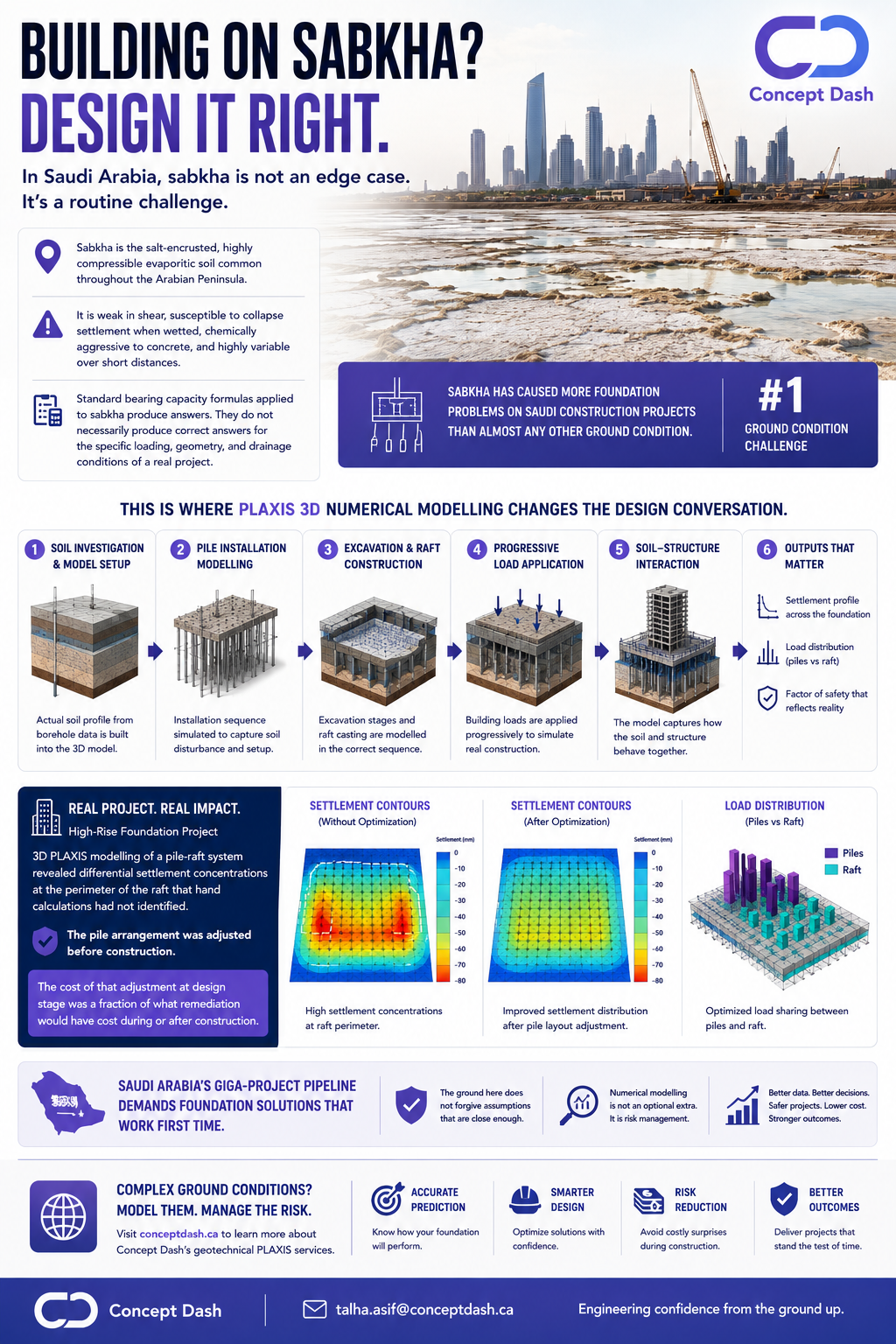
    The geotechnical conditions encountered on construction projects across Saudi Arabia are among the most complex and variable of any major construction market in the world. The Kingdom’s geology spans ancient crystalline basement rock in the western regions, deep sedimentary sequences in the Eastern Province, and the challenging near-surface soils of the central plateau — including sabkha deposits, gypsiferous horizons, and collapsible loess-type materials — that present significant engineering challenges for foundation and ground improvement design.

    Sabkha soils in particular — the evaporite-rich, saline, structurally sensitive soils found in coastal and near-coastal areas across the Arabian Peninsula — behave in ways that standard geotechnical design approaches were not developed to address. They are stiff when dry and heavily loaded, but vulnerable to collapse and significant settlement when wetted, or when load conditions change in ways that alter their moisture regime. Foundation designs that do not explicitly model this wetting collapse behaviour can fail to predict settlement magnitudes that lead to structural distress in the facilities built on them.

    What PLAXIS Does That Conventional Analysis Cannot

    Conventional geotechnical analysis — bearing capacity calculations, consolidation settlement estimates, simple slope stability analyses — produces useful design guidance for relatively uniform soil conditions under relatively straightforward loading scenarios. For the complex soil conditions and structural interactions of Saudi Arabia’s major infrastructure projects, conventional analysis has significant limitations.

    PLAXIS is a finite element geotechnical modelling platform that simulates soil and rock behaviour numerically, accounting for the complexity of soil-structure interaction that conventional methods simplify away. For a pile-raft foundation on a site with a complex layered soil profile, PLAXIS models the load distribution between the piles and the raft, the differential settlements that result, and the structural loads that those differential settlements generate in the raft structure — rather than treating the raft and the piles as separate elements with simplified interaction assumptions.

    For deep excavations — critical to metro station construction, basement development in urban Riyadh, and underground infrastructure in the giga-project programs — PLAXIS models the three-dimensional soil movements that surround the excavation, the interaction between the retaining structure and the surrounding ground, and the settlement impact on adjacent structures. This is the difference between knowing that the excavation support is structurally adequate and knowing how the surrounding ground will actually move as the excavation proceeds.

    Concept Dash’s PLAXIS Capability

    Concept Dash’s geotechnical team, led by Dr. Mahmoud Ibrahim, brings specialized PLAXIS modelling capability to infrastructure projects across Saudi Arabia and the GCC. Dr. Ibrahim’s expertise spans foundation design, ground improvement assessment, slope stability analysis, and the specific challenges of Saudi soil conditions — including sabkha behaviour, gypsiferous soil design, and the pile-raft foundation systems used extensively in Riyadh’s high-rise and heavy infrastructure programs.

    The PLAXIS capability we offer is not a modelling service applied generically to any geotechnical problem. It is a specialist service targeted at the problems where advanced numerical modelling produces design guidance that conventional analysis cannot provide: complex foundation systems, deep excavations in challenging ground, ground improvement design where the mechanism of improvement needs to be verified numerically, and slope stability analyses where the failure mechanism is not adequately captured by simple limit equilibrium methods.

    For infrastructure project teams in Saudi Arabia, the investment in PLAXIS analysis is typically recovered many times over in optimized foundation design, reduced ground improvement quantities, and confidence in design performance under the range of conditions the facility will experience. Foundation overdesign is expensive. Foundation underperformance is more expensive. Advanced numerical modelling closes the gap between the two.