Why Saudi Arabia’s Geology Demands Advanced Modelling
The geotechnical conditions encountered on construction projects across Saudi Arabia are among the most complex and variable of any major construction market in the world. The Kingdom’s geology spans ancient crystalline basement rock in the western regions, deep sedimentary sequences in the Eastern Province, and the challenging near-surface soils of the central plateau — including sabkha deposits, gypsiferous horizons, and collapsible loess-type materials — that present significant engineering challenges for foundation and ground improvement design.
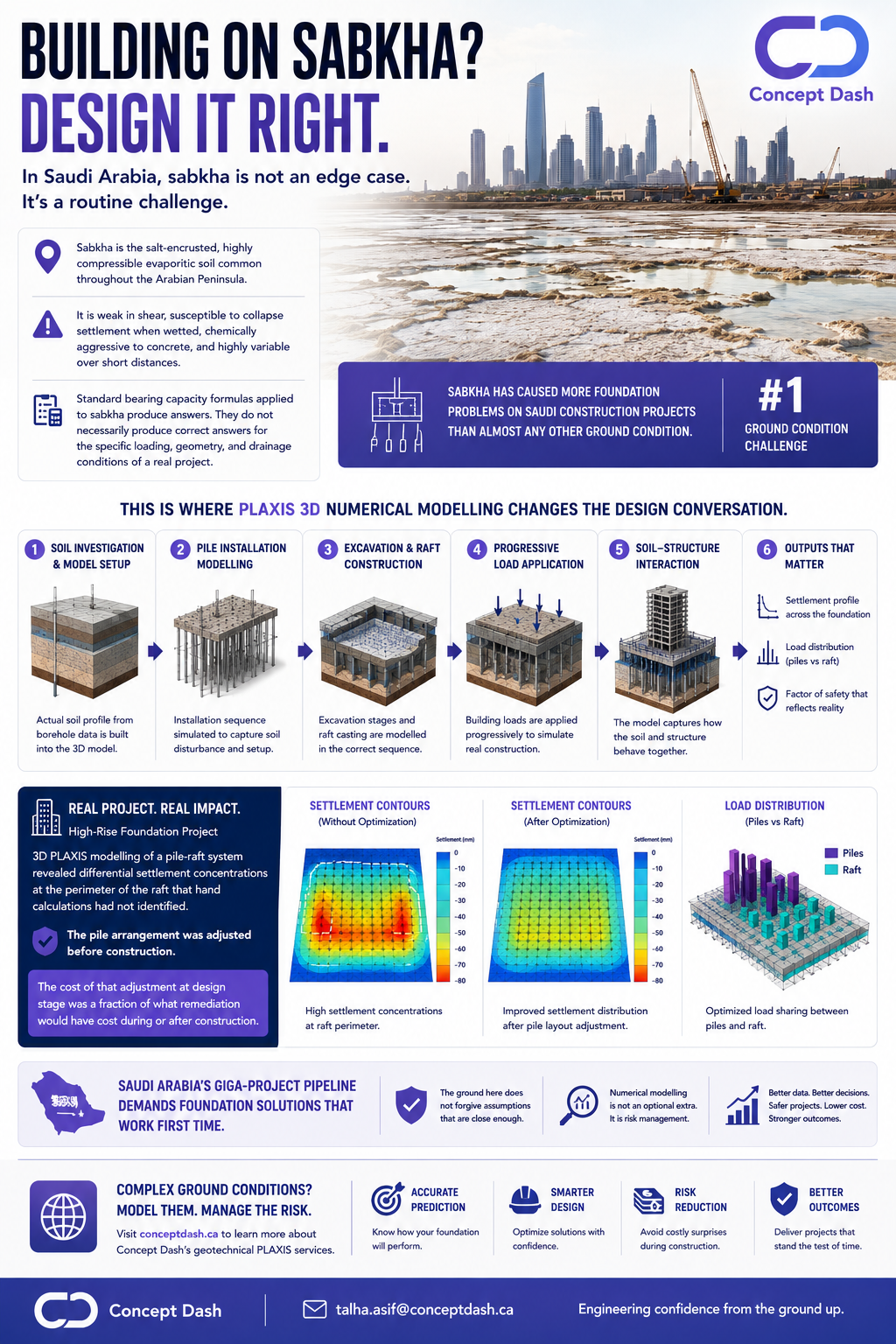
Sabkha soils in particular — the evaporite-rich, saline, structurally sensitive soils found in coastal and near-coastal areas across the Arabian Peninsula — behave in ways that standard geotechnical design approaches were not developed to address. They are stiff when dry and heavily loaded, but vulnerable to collapse and significant settlement when wetted, or when load conditions change in ways that alter their moisture regime. Foundation designs that do not explicitly model this wetting collapse behaviour can fail to predict settlement magnitudes that lead to structural distress in the facilities built on them.
What PLAXIS Does That Conventional Analysis Cannot
Conventional geotechnical analysis — bearing capacity calculations, consolidation settlement estimates, simple slope stability analyses — produces useful design guidance for relatively uniform soil conditions under relatively straightforward loading scenarios. For the complex soil conditions and structural interactions of Saudi Arabia’s major infrastructure projects, conventional analysis has significant limitations.
PLAXIS is a finite element geotechnical modelling platform that simulates soil and rock behaviour numerically, accounting for the complexity of soil-structure interaction that conventional methods simplify away. For a pile-raft foundation on a site with a complex layered soil profile, PLAXIS models the load distribution between the piles and the raft, the differential settlements that result, and the structural loads that those differential settlements generate in the raft structure — rather than treating the raft and the piles as separate elements with simplified interaction assumptions.
For deep excavations — critical to metro station construction, basement development in urban Riyadh, and underground infrastructure in the giga-project programs — PLAXIS models the three-dimensional soil movements that surround the excavation, the interaction between the retaining structure and the surrounding ground, and the settlement impact on adjacent structures. This is the difference between knowing that the excavation support is structurally adequate and knowing how the surrounding ground will actually move as the excavation proceeds.
Concept Dash’s PLAXIS Capability
Concept Dash’s geotechnical team, led by Dr. Mahmoud Ibrahim, brings specialized PLAXIS modelling capability to infrastructure projects across Saudi Arabia and the GCC. Dr. Ibrahim’s expertise spans foundation design, ground improvement assessment, slope stability analysis, and the specific challenges of Saudi soil conditions — including sabkha behaviour, gypsiferous soil design, and the pile-raft foundation systems used extensively in Riyadh’s high-rise and heavy infrastructure programs.
The PLAXIS capability we offer is not a modelling service applied generically to any geotechnical problem. It is a specialist service targeted at the problems where advanced numerical modelling produces design guidance that conventional analysis cannot provide: complex foundation systems, deep excavations in challenging ground, ground improvement design where the mechanism of improvement needs to be verified numerically, and slope stability analyses where the failure mechanism is not adequately captured by simple limit equilibrium methods.
For infrastructure project teams in Saudi Arabia, the investment in PLAXIS analysis is typically recovered many times over in optimized foundation design, reduced ground improvement quantities, and confidence in design performance under the range of conditions the facility will experience. Foundation overdesign is expensive. Foundation underperformance is more expensive. Advanced numerical modelling closes the gap between the two.